Mirror Affirmations and Big Ambitions: How a High School Internship Sparked a Career in Therapy
Written By: Kaitlin Streator, BB2C Communications and Engagement Coordinator
A large part of the work Building Bridges to Careers (BB2C) does to bridge the gap between education and employment is placing students in internships at local businesses within their communities. One internship program BB2C runs, in collaboration with the Appalachian Children Coalition, is the Behavioral Health Internship Program—an initiative that helps many students, like recent Edison High School graduate Lena Wagner, get a jump start on their careers in the behavioral health field.
"When I was in fourth grade, someone close to me was sent to rehab. After that, I just wanted to learn more about what they were going through. That’s when I decided I wanted to be a therapist,” Wagner said.

Lena Wagner is a 2026 Edison High School Grad
Luckily for Wagner, her high school career pathways coach and volleyball coach, Leah Eft, told her about the Behavioral Health Internship Program and encouraged her to apply.
“I personally love the program because it takes care of itself," Eft said. "There have been so many programs that come in and then expect the school to do all the work. This program is different. It is self-sufficient and hugely rewarding for the students. We aim to get students into as many work-related opportunities as possible, and these internships definitely meet that need. Not only does it give students experience, but it also gives them coaching and feedback on how they are doing. I think this helps students self-assess and analyze what they need to do better or differently, which is hugely important on a young person’s career path.”
Wagner, whose first internship was with Hopewell and involved researching specific behavioral health issues related to social media and teens, was able to learn from that initial experience and build upon her skills in her second internship.
“At first, I was rather shy and didn't ask for help, which was a challenge for me. But over time, I got better at reaching out and getting the guidance I needed,” Wagner said. "In an internship, unless you apply yourself and try to make it engaging, it won't be fun. I did hours of research—which most people would think is boring—but you can take fun notes, write interesting papers, and apply what you learn to your own life and the people around you."
Wagner prides herself on the project she implemented at her own high school following her research with Hopewell.
"Social media is terrible for teenagers' brains, yet everyone is on it anyway. For one of my projects, I wrote positive affirmations and compliments on the mirrors around school. Body dysmorphia and eating disorders are huge issues for teens, and a lot of people look in the mirror and don't have a good experience. I wanted to change that,” Wagner said. "There is a lot of missing potential in high schools. So many kids could do great things with their lives, but they’ve never had a good role model to show them what they can achieve. I just wanted to make them feel like they're capable."
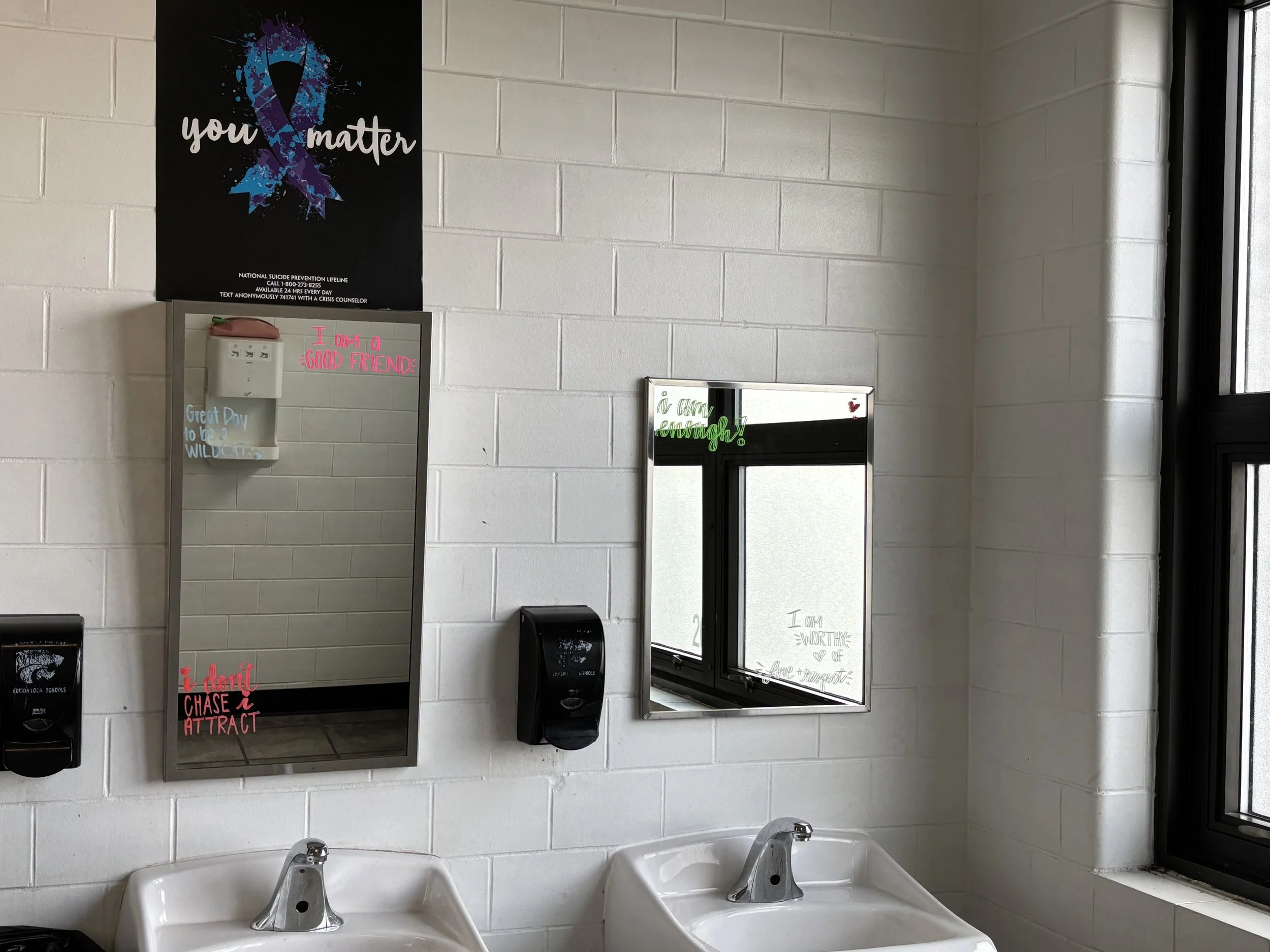
Wagner wrote positive affirmations and compliments on bathroom mirrors around her high school after learning about teenage mental health issues.
Wagner is attending the University of Akron in the fall, where she plans to study social work for four years to earn her master’s degree and hopefully complete certificates in substance and family counseling along the way. She has been able to narrow down her interests thanks to her internship with Hopewell as well as a second placement with Ohio Valley Counseling. Wagner noted that working in a physical clinic during her time with Ohio Valley Counseling solidified her desire to pursue this career path.
"Getting to be in the clinic in person really affirmed what I already knew: therapy is for everybody. People tend to stereotype who goes to therapy, but it’s cheerleaders, it’s kids who don't play sports, and it’s kids who sit in the library all day. Even the loudest, prettiest girl you know—everyone has their issues,” Wagner said. "My first mentor at the clinic was a step ahead of me in her education, so it was like having a guide to shadow. Being around so many counselors in different specialties affirmed that this is truly what I want to do."
Wagner said her internship experiences have allowed her to see just how many opportunities exist within social work, inspiring her to explore different options after graduating from Akron.
"My personal goal is to become a Licensed Clinical Social Worker (LCSW). After I graduate, I want to do travel social work for a few years to build my clinical hours, see new places, and pay down student debt. Eventually, I want to work in a clinic and maybe even offer telehealth from home. There are so many options, and I want to try them all."
Wagner’s enthusiasm has proven contagious, as she has encouraged other students at her school to apply for behavioral health internships.
"I would definitely recommend an internship program like this,” Wagner said. “Even if you don't know what you want to do, it never hurts to try. Emotional awareness is so important, and you might just find something you love."
Within the behavioral health talent ecosystem, students from elementary school to college and beyond have access to opportunities in the behavioral health field. Some students attend one-time events such as Discover Days, while others participate in immersive internships that contribute to degree attainment and job offers. All of these experiences build awareness of local behavioral health pathways. To learn more about the Behavioral Health Internship Program, visit bb2careers.org/student-internships.